
Linux has countless important commands which can do anything with ad to the operating system. If you are like me and coming from Windows and additionally have troubles remembering the most important commands, this post might help you - have a look - maybe you find the commands on CachyOS which you always forget ;)
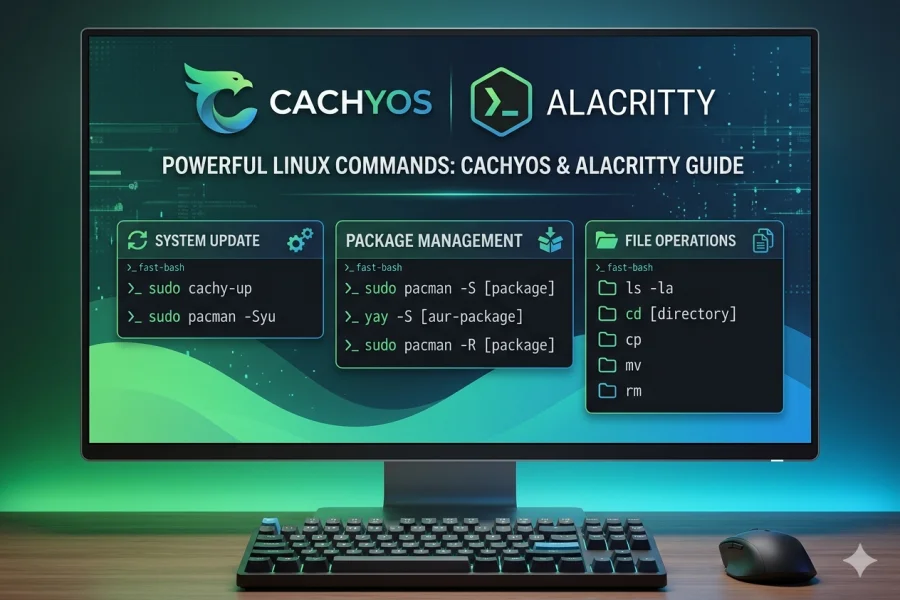
Introduction - The year of Linux #
2026 - it happened, I finally tried Linux and to be honest I am deeply impressed and not missing Windows at all. I thought about that move already some time ago but doe to the fact that i am also playing some Video games, I was little worried that this will cause several problems.
To my surprise, i hardly felt any impact at all, even the opposite, no driver installations, no compatibility issues, everything worked out of the box !
I am now using CachyOS and i am more than happy with it. I just suffer a little problem, i am very bad at remembering commands which I don’t need on daily basis. And thats the reason of this post, to document and note some of those important commands, so i can look them up whenever i need them. Hopefully you may also find some use for it.
Package Manager / Flatpak / Applications #
| Command | Description |
|---|---|
sudo pacman -Syu |
sync package database and update all applications |
sudo pacman -S <application> |
install/update defined application |
sudo pacman -Ss <application> |
information about which version is available (and which one is installed) |
sudo pacman -R <package name> |
remove package and any dependencies which are not required by other `applications |
sudo pacman -Rn <package name> |
remove package and any dependencies which are not required by other applications and all its configuration files |
sudo pacman -Rs $(pacman -Qtdq) |
removes all packages which are not needed (orphans) - kind of a clean up |
pacman -Q |
list all packages and versions |
pacman -Qe |
list all explicitly installed packages (by user) without dependencies |
yay -Syu |
sync package database and update all applications, yay includes non cachyos packages - discord for example |
flatpak update |
updates all packages |
flatpak install <application> |
install defined application |
flatpak update <application> |
updates specific application |
flatpak list --app |
show all applications installed via flatpak |
flatpak uninstall --delete-data <application> |
uninstall defined app and all app data stored in ~/.var/app/ |
flatpak uninstall --unused |
remove not needed dependencies |
Navigation #
| Command | Description |
|---|---|
cd .. |
navigate to parent directory |
cd <path> |
navigate to certain path |
cd ~ |
navigate to users home folder |
File operations #
| Command | Description |
|---|---|
rm <filename> |
removes file |
rm -r <directory> |
removes directory and all its content |
mv <source file> <destination file> |
move file from source to destination |